WhatsApp Us
Cyber Security

CRISC Certification Course

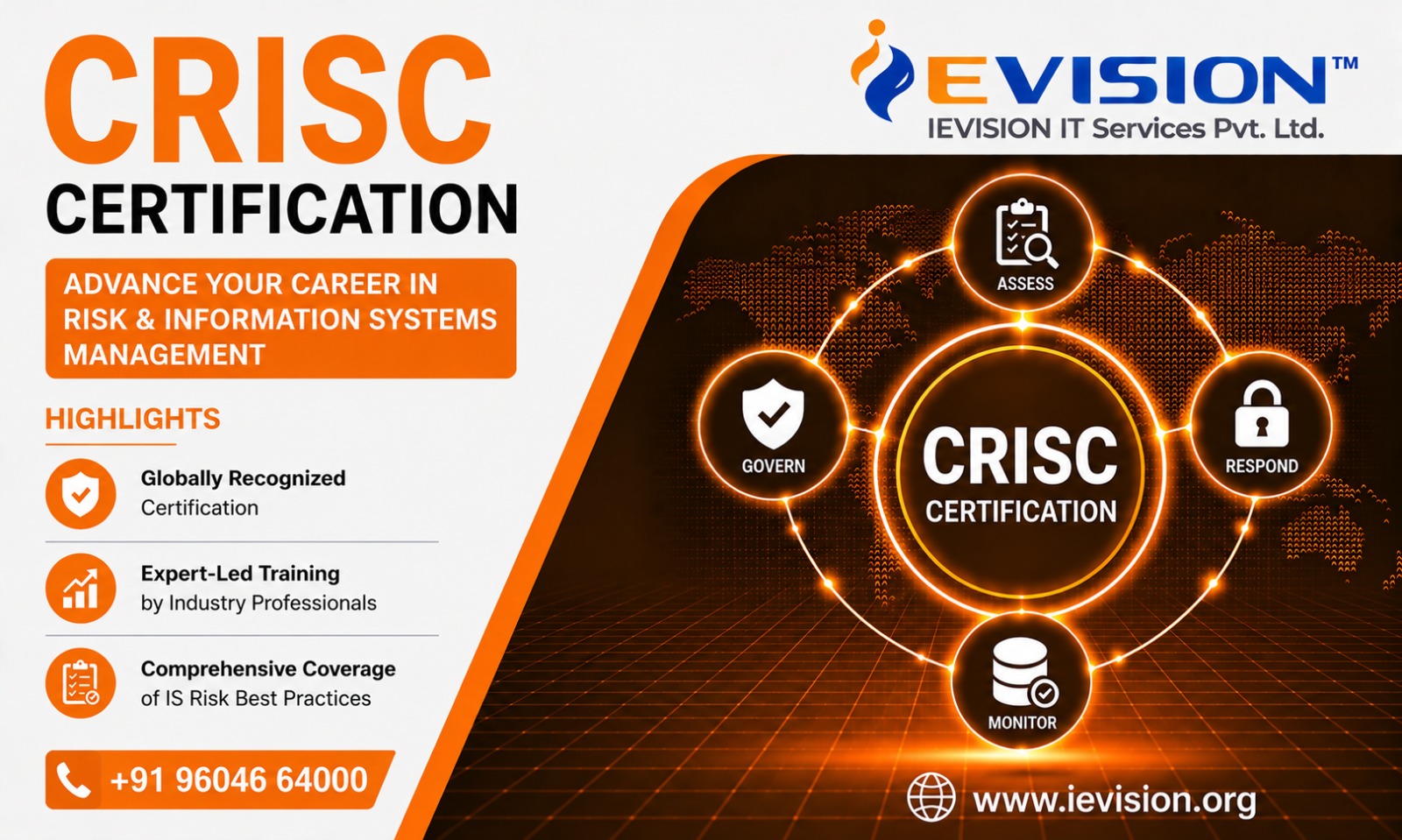
ISACA Certified in Risk and Information Systems Control (CRISC) is one of the world’s most respected certifications for IT risk management professionals. CRISC validates the ability to identify, assess, respond to, monitor, and report enterprise IT and cybersecurity risks while designing and evaluating information system controls.

Official ISACA CRISC Job Practice Coverage
Practical Risk Register and Control Workshops
Real-World Cyber and IT Risk Case Studies
600+ Practice Questions and Mock Tests
Expert-Led Training by Mahesh Pande with 25+ Years Experience
4.9/5
2,100+ reviews
12,400+
Students
95%
Placement

Course Video

CRISC Certification Course video preview
CRISC Certification Course
Watch course details, learning path, and certification outcomes.

Course Overview

IEVISION IT Services offers a comprehensive 4-Day Practical-Oriented CRISC Certification Training led by Mahesh Pande. This hands-on course is aligned with the latest ISACA CRISC Job Practice and includes real-world case studies, risk registers, control design workshops, quantitative and qualitative risk assessment examples, KPI/KRI dashboards, and exam-focused mock tests.

The training is specifically designed for professionals who want to build strong expertise in enterprise risk management, cyber risk governance, and information systems controls while preparing confidently for the CRISC certification exam.


CRISC 4 Domains and Weightage

  1. Domain 1: Governance – 26%
  2. Domain 2: IT Risk Assessment – 20%
  3. Domain 3: Risk Response and Reporting – 32%
  4. Domain 4: Information Technology and Security – 22%


CRISC Certification Exam

  • Certification Body: ISACA
  • Exam Format: 150 Multiple-Choice Questions
  • Duration: 4 Hours
  • Passing Score: 450 out of 800
  • Delivery: Computer-Based Testing
  • Exam Mode: Test Center or Remote Proctoring
  • Question Type: Scenario-Based and Conceptual
  • Exam Language: English and selected languages
  • Membership Discounts Available for ISACA Members
Who Should Attend

IT Risk Managers, Information Security Managers, IT Auditors, Internal Auditors, Compliance Officers, GRC Professionals, Cybersecurity Analysts, Security Consultants, Control Owners, Business Continuity Managers, Vendor Risk Managers, SOC Managers, IT Managers, CISOs, Professionals preparing for CRISC certification

Course Highlights

32
32 Hours of extensive training
4
Full Day Course or customizable
25
25+ Experienced Cyber Security & Systems Auditor Trainer
98%
Highest Success Rate

Batch Schedules

Pick a cohort that matches your availability. Limited seats per batch to ensure hands-on mentor support and lab guidance.

New batches will be announced soon
Stay tuned
Upcoming schedule information is not available yet.

Course Curriculum

Module 1: Domain 1: Governance (26%)

Module 1: Enterprise Risk Governance

  • Governance principles and frameworks
  • Roles of board, management and risk committees
  • Risk culture and accountability
  • Risk appetite and tolerance
  • Policies and standards

Module 2: Strategic Alignment

  • Business objectives and risk alignment
  • Stakeholder expectations
  • Regulatory requirements
  • Three lines model
Module 2: Domain 2: IT Risk Assessment (20%)

Module 3: Risk Identification

  • Assets, threats and vulnerabilities
  • Risk scenarios (top-down and bottom-up)
  • Threat intelligence
  • Control deficiencies

Module 4: Risk Analysis and Evaluation

  • Impact and likelihood analysis
  • Quantitative and qualitative methods
  • Inherent and residual risk
  • Risk heat maps
  • Prioritization
Module 3: Domain 3: Risk Response and Reporting (32%)

Module 5: Risk Treatment

  • Mitigate, transfer, avoid and accept
  • Control selection and design
  • Action plans and ownership

Module 6: Monitoring and Reporting

  • KPI and KRI development
  • Risk dashboards
  • Escalation and communication
  • Executive reporting
Module 4: Domain 4: Information Technology and Security (22%)

Module 7: Security and Technology Fundamentals

  • Information security controls
  • Cloud and third-party risk
  • Business continuity and disaster recovery
  • Emerging technology risks

Module 8: Exam Preparation Workshop

  • Domain-wise review
  • Practice questions
  • Mock tests
  • Exam strategies and study plan
Career Growth Focus

Career Outcomes That Matter

CIRISC Certification Training

Talk to a Career Advisor
20 CRISC / CIRISC Certification
10 Role of risk professionals
Target Role
Salary Range (India)
Demand Trend
Admin
8 LPA
High In Demand
Designer
10 LPA
Significant Demand

Top Hiring Companies

Google
TOSS
NTT DATA
OWEBEST
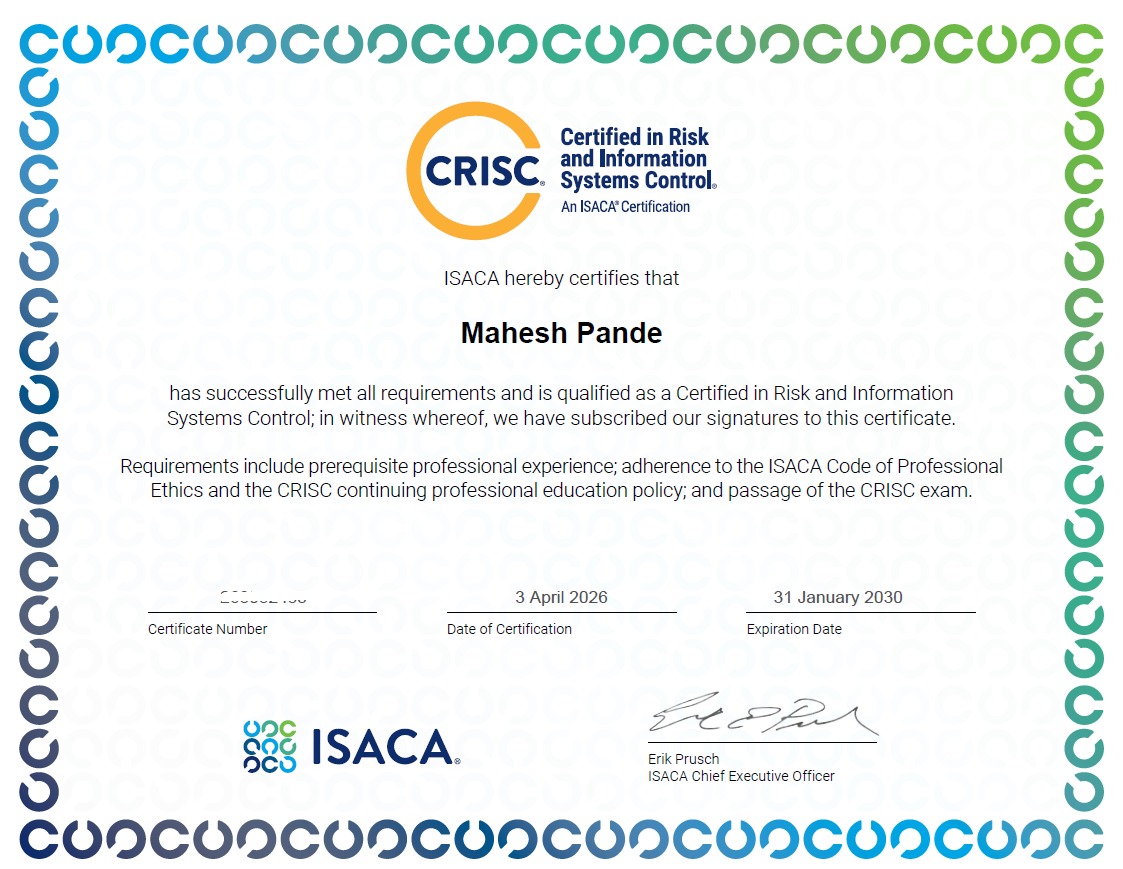
GET THE APPLIED CRISC Certification Course CERTIFICATION

Earn the Coveted Applied CRISC Certification Course Certification

CRISC Certification Course sample certificate
Sample Certificate (JPG / PNG)

Meet Your Instructors

Mahesh Pande
Mahesh Pande
CISA, CRISC, ISO 42001, ISO 27001, ISO 22301, ISO 31000, ISO 27701, ISO 20001, COBIT, SIAM, ITIL
Principal Consultant - 25+ yrs. Experience APMG, TUV-SUD, EXIN, PEOPLECERT, EXCELCERT & IRCLASS Accredited CISA and CRISC Traine...
India 5.0/5

Our Learners Love Us

Approved learner reviews will appear here after students submit feedback.

Frequently Asked Questions

1. What is the objective of the CIRISC Training program?

The primary objective of the CIRISC Training program is to equip participants with comprehensive knowledge, practical skills, and industry-relevant expertise in CIRISC concepts, methodologies, and implementation practices. The course is designed to bridge the gap between theoretical understanding and real-world application, enabling professionals to confidently handle business, technical, and operational challenges within their respective domains.

2. Who should attend the CIRISC Training course?

This training program is ideal for:

  • IT professionals
  • Risk and compliance specialists
  • Cybersecurity professionals
  • Fresh graduates seeking industry-oriented training
  • Working professionals looking for upskilling opportunities
  • Corporate teams involved in governance, risk, and security functions

The course is structured to support both beginners and experienced professionals.

3. What are the eligibility criteria or prerequisites for enrollment?

There are no strict mandatory prerequisites for joining the CIRISC Training course. However, basic knowledge of:

  • Information technology
  • Risk management concepts
  • Compliance frameworks
  • Cybersecurity fundamentals

will be beneficial for better understanding and faster learning progression.


4. What are the eligibility criteria or prerequisites for enrollment?

There are no strict mandatory prerequisites for joining the CIRISC Training course. However, basic knowledge of:

  • Information technology
  • Risk management concepts
  • Compliance frameworks
  • Cybersecurity fundamentals

will be beneficial for better understanding and faster learning progression.

5. What topics and modules are covered in the CIRISC Training curriculum?


The curriculum covers a professionally designed set of modules, including:

  • Introduction to CIRISC framework
  • Risk identification and assessment
  • Information security controls
  • Compliance standards and governance
  • Incident response and mitigation
  • Case-based practical implementation
  • Industry best practices
  • Reporting and documentation methodologies
  • Audit and review processes
  • Real-time project scenarios

The content is aligned with current industry standards and practical use cases.


6. What topics and modules are covered in the CIRISC Training curriculum?

The curriculum covers a professionally designed set of modules, including:

  • Introduction to CIRISC framework
  • Risk identification and assessment
  • Information security controls
  • Compliance standards and governance
  • Incident response and mitigation
  • Case-based practical implementation
  • Industry best practices
  • Reporting and documentation methodologies
  • Audit and review processes
  • Real-time project scenarios

The content is aligned with current industry standards and practical use cases.

7. What is the duration and schedule of the training program?

The duration of the CIRISC Training program typically depends on the selected batch format:

  • Weekday batches: 1–2 hours per day
  • Weekend batches: Extended 3–4 hour sessions
  • Corporate fast-track sessions: Customized duration

The complete program generally ranges from 4 to 8 weeks, depending on depth and delivery mode.


8. What is the duration and schedule of the training program?

The duration of the CIRISC Training program typically depends on the selected batch format:

  • Weekday batches: 1–2 hours per day
  • Weekend batches: Extended 3–4 hour sessions
  • Corporate fast-track sessions: Customized duration

The complete program generally ranges from 4 to 8 weeks, depending on depth and delivery mode.

9. Is the CIRISC Training available in online, offline, or hybrid mode?

Yes, IEVISION IT SERVICES offers flexible learning modes:

  • Online instructor-led live sessions
  • Offline classroom training (subject to location availability)
  • Hybrid mode for selected corporate and institutional programs

This flexibility allows professionals and students to choose the most convenient learning format.


10. Is the CIRISC Training available in online, offline, or hybrid mode?

Yes, IEVISION IT SERVICES offers flexible learning modes:

  • Online instructor-led live sessions
  • Offline classroom training (subject to location availability)
  • Hybrid mode for selected corporate and institutional programs

This flexibility allows professionals and students to choose the most convenient learning format.

11. Are there any practical sessions, case studies, or hands-on exercises included?

Absolutely. The program strongly emphasizes practical learning through:

  • Real-time case studies
  • Hands-on exercises
  • Scenario-based assignments
  • Live demonstrations
  • Mock project implementations
  • Industry problem-solving sessions

This ensures participants gain applied knowledge beyond theory.

12. Who are the trainers or instructors conducting the CIRISC Training?

The CIRISC Training is professionally conducted by Mr. Mahesh Pande, an experienced industry expert associated with IEVISION IT SERVICES.

Mr. Pande brings extensive professional experience, domain expertise, and practical industry insights, ensuring high-quality training delivery with real-world examples and professional mentoring.

13. Will participants receive study materials, manuals, or recorded sessions?

Yes, enrolled participants receive comprehensive learning support materials, including:

  • Training manuals
  • Presentation notes
  • Reference documents
  • Practice exercises
  • Case study documents
  • Session recordings (for online batches, if applicable)

These materials help in revision and long-term reference.

14. Is there any certification provided upon successful completion of the training?

Yes, participants who successfully complete the training program and required assessments receive a Professional Course Completion Certificate from IEVISION IT SERVICES.

This certification can be valuable for:

  • Resume enhancement
  • Professional credibility
  • Internal promotions
  • Job applications
15. What is the assessment or evaluation process for certification?

The certification process may include:

  • Attendance requirements
  • Module-wise assignments
  • Practical exercises
  • Final assessment test
  • Case study submission
  • Trainer evaluation

Successful completion of these criteria qualifies participants for certification.

Have a Query? We're Just a Message Away.

Why IEVISION

Why Choose IEVISION?

We go beyond teaching, we build careers.

Expert-Led Live Training

Learn from industry practitioners with 10-20 years of real-world experience across enterprise teams.

Globally Recognized Certifications

Train for leading certifications across cybersecurity, cloud, AI, and governance tracks.

Placement Assistance

Get resume reviews, mock interviews, and personalized support for role transitions and growth.

Hands-on Lab Access

Practice with guided labs, projects, and sandbox exercises aligned to real implementation scenarios.

Flexible Learning Options

Choose from live weekend, weekday, and fast-track formats based on your availability.

24/7 Learner Support

Stay supported with trainer access, learner community help, and dedicated coordination assistance.