The Certified Information Systems Auditor or CISA course is designed to prepare professionals with the in-depth knowledge and hands-on skills required to audit, monitor, and safeguard enterprise information systems. This focuses on IT systems across complex organizational environments, like: The certified information systems auditor course addresses all five ISACA-defined domains. This includes IS audit processes, IT governance, systems acquisition controls, operational resilience, and information asset security. In terms of compliance alignment, the curriculum is built around internationally recognized standards, including ISO/IEC 27001, COBIT, GDPR, and ISACA's own Code of Professional Ethics. This CISA certification helps participants develop a practical command of conducting IS audits, managing IT risks, and strengthening internal controls to reduce organizational vulnerabilities and meet regulatory expectations.
CISA Certification Course
Our CISA course teaches how to plan and execute information systems audits, evaluate IT governance structures, and assess internal controls by mastering all five ISACA-aligned domains.
Let this certified information systems auditor training help you gain expertise in IS audit methodologies, IT risk frameworks, and enterprise control evaluation through the course modules offered by IEVISION in Pune.
CISA certification is essential as it validates a professional's ability to audit, control, and secure enterprise information systems in line with globally accepted standards. It demonstrates that an individual has the expertise to identify weaknesses in IT environments, recommend corrective measures, and ensure that information systems operate with integrity and reliability.
Beyond individual credibility, a CISA certification also helps organizations meet audit and compliance mandates, protect sensitive data, and build confidence among stakeholders. The CISA credential is tangible proof that you understand how to bring accountability and assurance to an organization's IT landscape.
There is no strict prerequisite to register for the CISA examination, making this certified information systems auditor course accessible to a wide range of professionals. It is particularly beneficial for:
Pick a cohort that matches your availability. Limited seats per batch to ensure hands-on mentor support and lab guidance.
This domain builds the core competencies needed to plan, conduct, and report on IS audits professionally and ethically, including:
This domain of the Cisa Course equips professionals to evaluate IT governance structures and ensure that organizational IT strategies align with business objectives, covering:
IT Governance:
IT Management:
This domain of the certified information systems auditor certification training focuses on evaluating controls throughout the systems development and implementation lifecycle, covering:
Acquisition and Development:
Implementation:
This domain strengthens a professional's ability to assess IT operational controls and evaluate an organization's capacity to withstand and recover from disruptions, covering:
Information Systems Operations:
Business Resilience:
This domain develops a professional's understanding of cybersecurity principles, threat landscapes, and the controls needed to protect organizational information assets, covering:
Information Asset Security and Control:
Security Event Management:
Become a globally recognized IT Audit, Risk, Governance, and Information Security professional with excellent career growth and high-paying job opportunities.
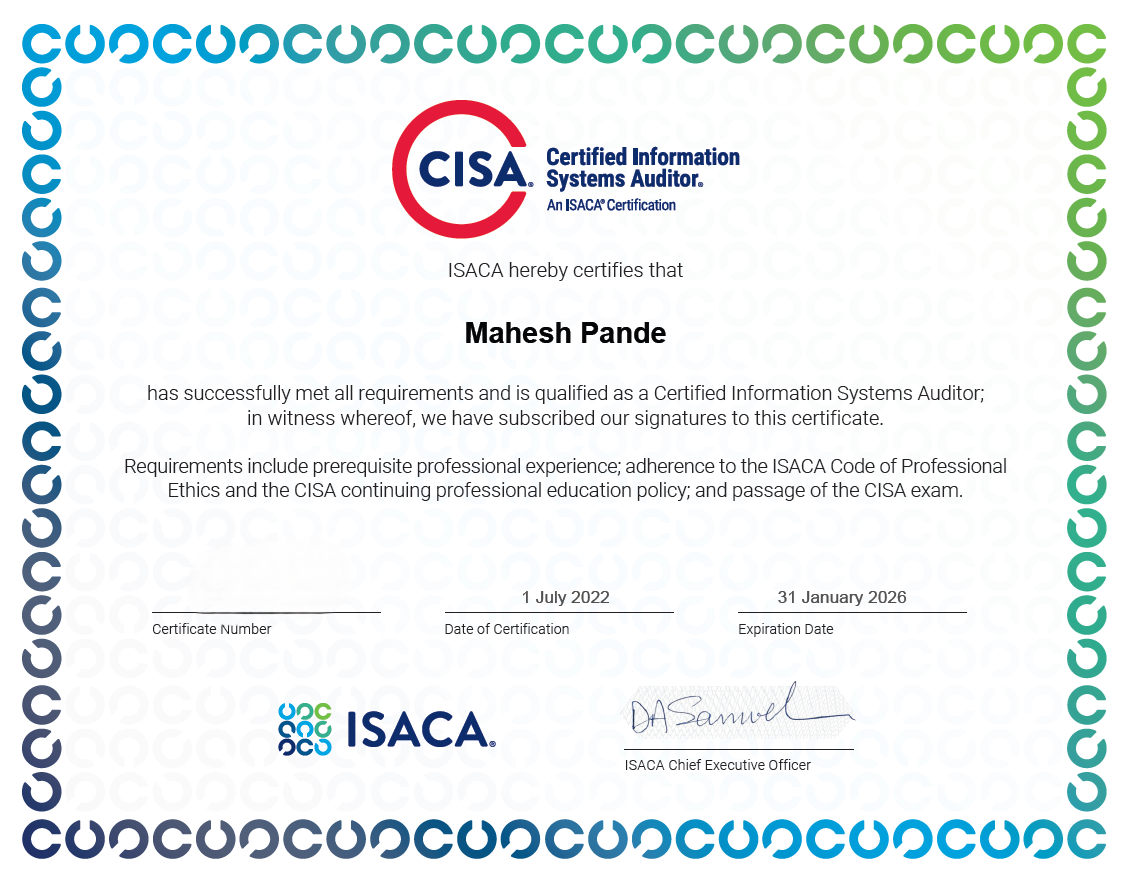

CISA training refers to the instructor-led preparation program that equips you with the knowledge and exam strategies needed to pass the CISA examination. CISA certification, on the other hand, is the official credential awarded by ISACA after you pass the exam and fulfill the required work experience criteria. Training is the preparation; certification is the outcome.
CISA-certified professionals are in high demand across Banking and Financial Services, IT and Technology, Government and Public Sector, Healthcare, Telecom, and Insurance. Any industry that relies on information systems and is subject to regulatory oversight actively seeks CISA-qualified individuals to manage audit, risk, and compliance functions.
CISA integrates cybersecurity directly into its audit framework through Domain 5, Protection of Information Assets, which covers identity and access management, network and endpoint security, data encryption, cloud and virtualized environments, mobile and IoT security, and security incident response. Rather than treating cybersecurity as a standalone subject, CISA approaches it through an audit and control lens, enabling professionals to evaluate the effectiveness of security measures within the broader IT governance structure.
Yes. To maintain the CISA certification, holders must earn a minimum of 20 Continuing Professional Education (CPE) hours annually and complete 120 CPE hours over a three-year certification period. An annual maintenance fee must also be submitted to ISACA. These requirements ensure that certified professionals stay current with the evolving landscape of IS audit, risk, and information security practices.
With regular, focused self-study, most participants are exam-ready within 4 to 6 weeks after completing the training. The timeline may vary depending on prior experience in IT audit, governance, or information security. IEVISION's structured mock tests, practice questions, and domain-wise study guidance help significantly reduce preparation time and improve first-attempt success rates.
There are no strict prerequisites to register for the CISA training or sit for the examination. However, to obtain the official CISA certification after passing the exam, candidates must demonstrate a minimum of 5 years of professional experience in information systems audit, control, or security. A waiver of up to one year is available for candidates holding a four-year university degree or an equivalent recognized qualification.
IEVISION follows a structured and practical training methodology designed to maximize both conceptual clarity and exam readiness. This includes:
Yes, you can cancel your enrolment and receive a full refund. Please refer to IEVISION's cancellation policy on the website for detailed terms and timelines.
Candidates who do not pass the CISA exam can retake it after a waiting period. ISACA allows candidates to attempt the exam up to four times within a rolling twelve-month period. Each retake requires a separate exam registration and payment of the applicable exam fee. IEVISION's post-training support and practice resources are available to help you prepare more effectively for subsequent attempts.
Yes. CISA is one of the most widely recognized and respected certifications in the field of information systems auditing and IT governance. Since its establishment in 1978, the CISA credential has been adopted as a global standard by organizations across Banking, Financial Services, Government, Healthcare, IT, and Telecom sectors. Employers in over 180 countries actively seek CISA-certified professionals for audit, risk, and compliance roles, making it one of the most valuable credentials for career growth in information security and governance.
CISA-certified professionals in India command competitive salaries that vary based on experience, industry, and job role. Entry to mid-level professionals with CISA certification typically earn between INR 6 to 14 lakhs per annum, while senior professionals in IT audit, risk management, or governance roles can earn upwards of INR 20 to 35 lakhs per annum. In Big 4 firms and multinational organizations, CISA certification often accelerates promotion timelines and opens access to higher compensation bands.
CISA is aimed at professionals with at least 5 years of experience in IT audit or security. However, freshers can attend training and take the exam, which allows them up to 10 years to fulfill the experience requirement after passing. For newcomers in IT audit or security, passing the CISA exam early provides a strong advantage in the job market.
The CISA course provides professionals with a solid understanding of data governance, privacy principles, and compliance frameworks aligned with GDPR. Participants learn to evaluate data classification policies and organizational controls against international standards, enabling them to conduct data privacy audits, identify compliance gaps, and recommend corrective measures for GDPR obligations.
Yes, absolutely. When you register for the training as a group of four or more professionals, we are pleased to offer you a special discount on the total registration fee. This not only makes the training more affordable for your team but also encourages collaboration and networking among participants. We look forward to having your group join us for this valuable experience!
CISA-certified consultants and trainers come with significant exposure to IT Security implementation and auditing. Our trainers possess various Information Security certifications like CISA, CISSP, CISM, CGEIT, COBIT, and ISO 27001 LI.
Explore similar programs learners usually take along with this track.
We go beyond teaching, we build careers.
Learn from industry practitioners with 10-20 years of real-world experience across enterprise teams.
Train for leading certifications across cybersecurity, cloud, AI, and governance tracks.
Get resume reviews, mock interviews, and personalized support for role transitions and growth.
Practice with guided labs, projects, and sandbox exercises aligned to real implementation scenarios.
Choose from live weekend, weekday, and fast-track formats based on your availability.
Stay supported with trainer access, learner community help, and dedicated coordination assistance.