Frequently Asked Questions
What is CRISC Certification?
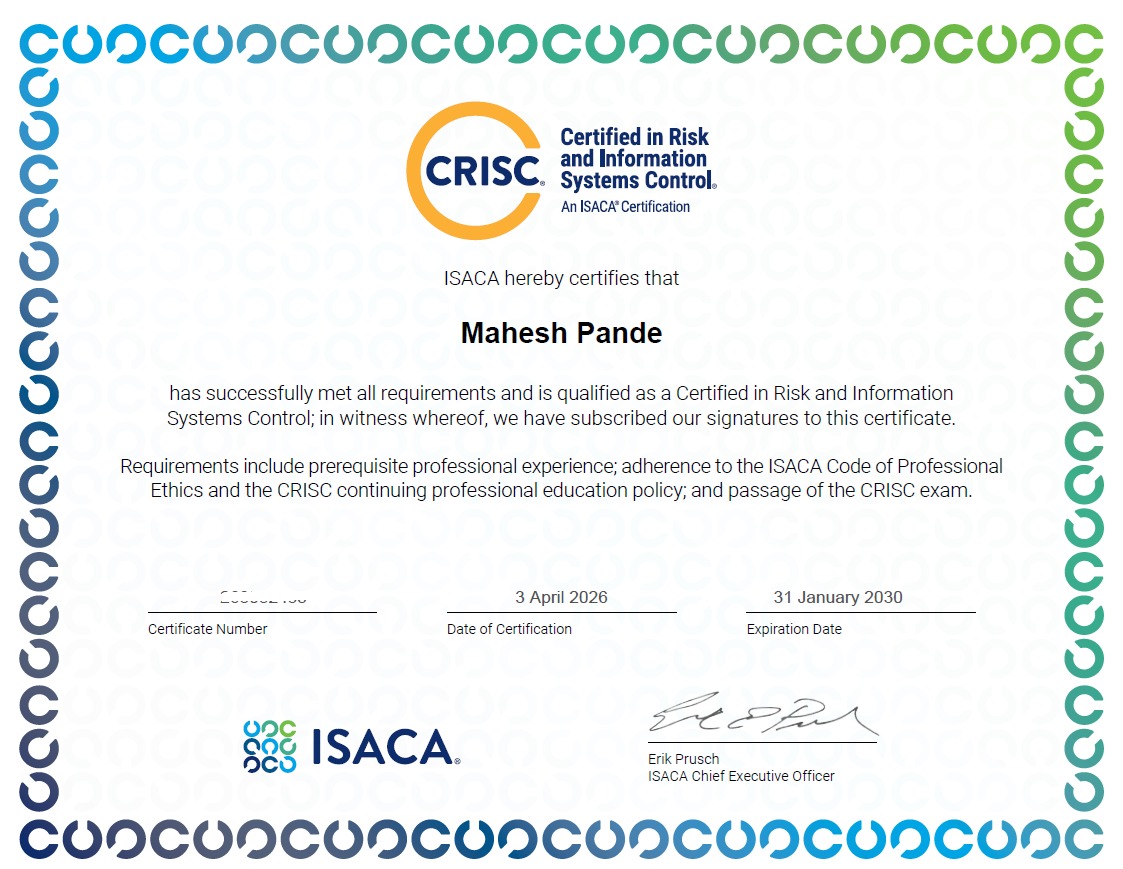
CRISC stands for Certified in Risk and Information Systems Control. It is a globally recognised certification offered by ISACA for professionals working in IT risk management, information systems controls, cybersecurity risk, and enterprise risk governance.
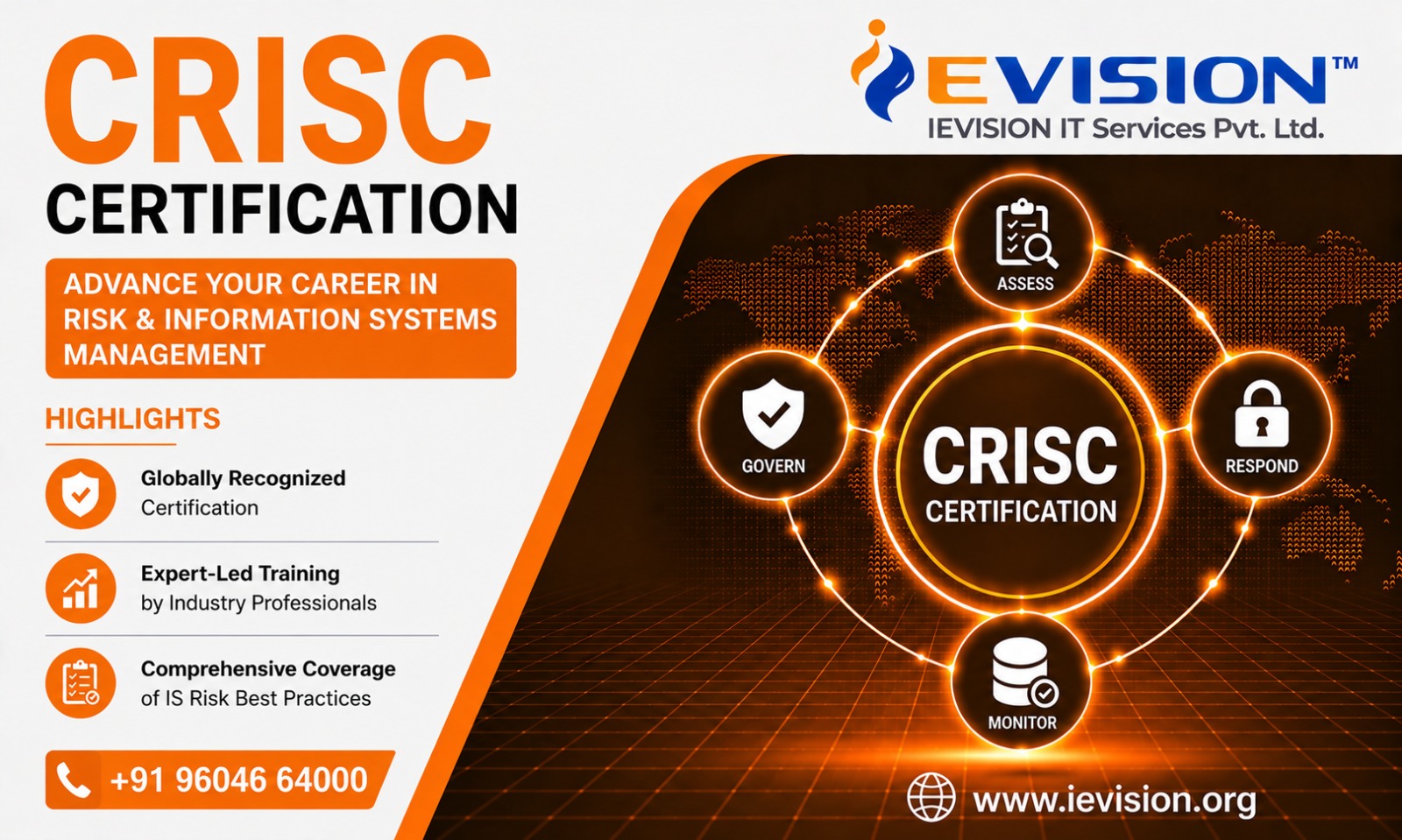
CRISC helps professionals understand how to identify, assess, respond to, and monitor IT-related business risks. It is particularly valuable for IT risk managers, information security professionals, IT auditors, and GRC consultants.
What are the domains and their weightings in CRISC Certification?
The CRISC examination covers four domains under the current ISACA examination content outline.
Domain — Weightage
Domain 1: Governance — 26%
Domain 2: Risk Assessment — 22%
Domain 3: Risk Response and Reporting — 32%
Domain 4: Technology and Security — 20%
Total — 100%
Risk Response and Reporting carries the highest weightage. However, candidates should prepare for all four domains because the CRISC examination evaluates their ability to apply risk management concepts to real business situations.
What is the eligibility for CRISC Certification?
You can appear for the CRISC examination without meeting the work experience requirement beforehand.
However, to obtain the CRISC certification, ISACA requires at least three years of cumulative professional experience performing CRISC-related tasks across at least two CRISC domains. One of those domains must be Domain 1 or Domain 2. Candidates must also meet ISACA's certification application requirements.
Is there any experience waiver for CRISC Certification?
No. ISACA does not currently offer an educational qualification waiver or substitution for the mandatory three years of CRISC professional experience.
An MBA, engineering degree, or another professional certification may help you understand the subject, but it does not replace the required CRISC work experience.
How should I prepare for the CRISC Certification Exam?
Start by understanding the four CRISC domains and their relationship to enterprise risk management. Focus on risk identification, assessment, risk treatment, control effectiveness, and risk reporting.
I recommend attending structured CRISC certification training, studying the official ISACA CRISC Review Manual, and practising scenario-based questions. The objective should be to develop a risk management mindset rather than simply memorising answers.
What is the CRISC Exam format?
The ISACA CRISC examination consists of 150 multiple-choice questions, with four hours available to complete the examination.
Questions assess your understanding of risk management concepts and your ability to apply them to practical business situations. The examination is computer-based and includes scenario-oriented questions that test professional judgement.
What is the CRISC Certification Exam fee?
ISACA's published standard CRISC examination registration fees have been approximately USD 575 for ISACA members and USD 760 for non-members. These amounts should be verified on ISACA's official website before registration because fees can change.
The examination fee is separate from CRISC training fees, certification application fees, membership fees, and applicable taxes.
What is the best approach to answer CRISC Exam questions?
The CRISC examination tests how a risk management professional should make decisions from a business perspective.
Read each question carefully, identify the risk scenario, and understand whether the question asks for the FIRST, BEST, MOST appropriate, or PRIMARY action. Consider business objectives, risk appetite, accountability, and the effectiveness of controls before selecting an answer.
Remember that the technically strongest solution is not always the most appropriate business risk decision.
Do I need an IT background to pass the CRISC Exam?
A technical IT background is helpful, but you do not need to be a programmer, network engineer, or cybersecurity specialist to pass the CRISC examination.
Professionals from audit, compliance, finance, business risk, and governance backgrounds can prepare successfully. However, you should develop a working understanding of information systems, IT controls, cybersecurity risks, and business processes.
Is IT Risk Management work experience compulsory to appear for the CRISC Exam?
No. You can register for and pass the CRISC examination without prior IT risk management experience.
However, professional experience is compulsory when applying for CRISC certification. ISACA requires three years of relevant experience meeting its domain requirements. Passing the examination and obtaining the certification are two separate milestones.
How do I register for the ISACA CRISC Exam?
You can register for the CRISC examination through ISACA's official website, www.isaca.org.
Create an ISACA account, select the CRISC certification examination, complete the registration, and pay the applicable fee. After registration, follow the scheduling instructions to select an available examination appointment through ISACA's authorised examination delivery provider.
Where can I take the CRISC Certification Exam?
The CRISC examination is delivered through authorised computer-based examination facilities. ISACA may also offer remotely proctored examination options, depending on current examination policies and availability.
Candidates should check the official ISACA examination scheduling system for available locations, appointment dates, and delivery options.
What is the passing score for the CRISC Exam?
You must achieve a minimum scaled score of 450 out of 800 to pass the ISACA CRISC examination.
This is not the same as answering 45% of questions correctly. ISACA uses a scaled scoring system to maintain consistency across different versions of the examination.
What is the validity of CRISC Certification?
The CRISC certification does not have a fixed expiry date, provided you continue to meet ISACA's certification maintenance requirements.
You must earn Continuing Professional Education (CPE) credits, pay annual certification maintenance fees, and follow ISACA's professional ethics requirements. Failure to maintain these requirements may result in certification revocation.
How do I maintain my CRISC Certification?
To maintain your CRISC certification, you must earn at least 20 CPE hours every year and complete a minimum of 120 CPE hours over a three-year reporting cycle.
You must also pay the annual certification maintenance fee, comply with ISACA's Code of Professional Ethics, and maintain supporting CPE records.
Do I need ISACA Membership to appear for the CRISC Exam?
No. ISACA membership is not compulsory to register for or appear for the CRISC certification examination.
However, ISACA members receive discounted examination registration fees and may receive other benefits, including access to professional resources, networking opportunities, and learning activities. I recommend comparing the membership cost and benefits before registering.
How much time should I spend daily preparing for the CRISC Exam?
I recommend spending approximately 1.5 to 2 hours daily preparing for the CRISC examination over 8 to 12 weeks. The actual preparation time depends on your experience in IT risk management, governance, and information systems controls.
Spend time understanding concepts, solving practice questions, and reviewing incorrect answers. Consistent daily preparation is generally more effective than studying for long hours only during weekends.
What are the best study materials and practice questions for CRISC Certification?
The official ISACA CRISC Review Manual and CRISC Questions, Answers & Explanations (QAE) resources are among the most useful materials for examination preparation.
I also recommend using the current CRISC examination content outline, structured training notes, risk assessment case studies, and mock examinations. Avoid relying entirely on memorised question banks because CRISC tests your ability to make risk-based decisions.
Which training provider should I choose for CRISC Certification Training?
Choose a CRISC training provider with experienced trainers who understand enterprise risk management, information security, governance, and practical risk assessment.
IEVISION IT Services Pvt. Ltd. offers instructor-led CRISC certification training focused on explaining concepts in simple language, connecting them with real business situations, and helping candidates develop the right examination approach.
I am sharing a demo link for CRISC Training and will give you confidence to join the session https://youtu.be/xY0DJVxByB4 .
What is the difference between passing the CRISC Exam and obtaining CRISC Certification?
Passing the CRISC examination demonstrates that you have achieved ISACA's required examination score. However, passing the examination does not automatically make you CRISC certified.
To obtain CRISC certification, you must also meet the required professional experience criteria, submit the certification application, pay the applicable processing fee, and comply with ISACA's professional requirements.
How do I apply for CRISC Certification after passing the exam?
After passing the CRISC examination, log in to your ISACA account and complete the certification application process.
You must provide details of your relevant professional experience, obtain the required experience verification, and pay the certification application processing fee of USD 50. ISACA requires candidates to apply within five years of passing the examination.
Which certification is best for a career in IT Risk Management?
CRISC is one of the most relevant professional certifications for individuals who want to build careers in IT risk management, enterprise risk management, technology risk consulting, and GRC.
If your career focuses on IT auditing, CISA may be more suitable. If you want to specialise in information security management, CISM is another strong option. CRISC is particularly valuable for professionals responsible for assessing technology risks and recommending appropriate risk responses.
How can CRISC Certification help me advance my career?
CRISC certification can strengthen your professional credibility by demonstrating your knowledge of IT risk assessment, risk response, governance, and information systems controls.
It can help you move toward responsibilities involving enterprise risk management, cybersecurity risk governance, risk advisory, and senior GRC roles. CRISC is especially useful when your work involves communicating technology risks to business management and supporting risk-based decisions.
What are the job opportunities after CRISC Certification?
CRISC-certified professionals may pursue opportunities in IT risk management, cybersecurity governance, technology risk consulting, information systems controls, and enterprise GRC.
Common job roles include IT Risk Manager, Technology Risk Consultant, GRC Manager, Information Security Risk Manager, Risk and Compliance Manager, IT Controls Manager, and Cybersecurity Risk Consultant.
Actual career opportunities depend on your professional experience, technical knowledge, business understanding, and ability to apply risk management principles.
Mahesh Pande: Principal Consultant over 25+ yrs. Experience
APMG Accredited CISA and CRISC Trainer,
Professionals Trained from 55 countries,
Trained More than 10,000+ Professionals,
Delivered over 800+ Training Programs,
CCC- Professional Cloud Security Manager, ISO 27001 LI & LA, COBIT5 Implementer, ISO 37301 LI & LA, ISO 31000 Risk Manager, ISO 20000 LI & LA, ISO 22301 LI, Delivered over 500+ Audits, ITIL Expert, CCC- Professional Cloud Service Manager, PRINCE2 Practitioner, GDPR Implementer,
APMG-International, TUV-SUD, PECB , PEOPLECERT & EXIN Accredited Trainer
4.8/5 Customer Satisfaction Rating
https://www.linkedin.com/in/mahesh-pande-accredited-trainer-and-consultant-29741b11